Architecture Overview 🟡 BETA
botserver is a single Rust binary wired to feature libraries, an Axum HTTP surface, a Rhai-based BASIC interpreter and a set of external services.
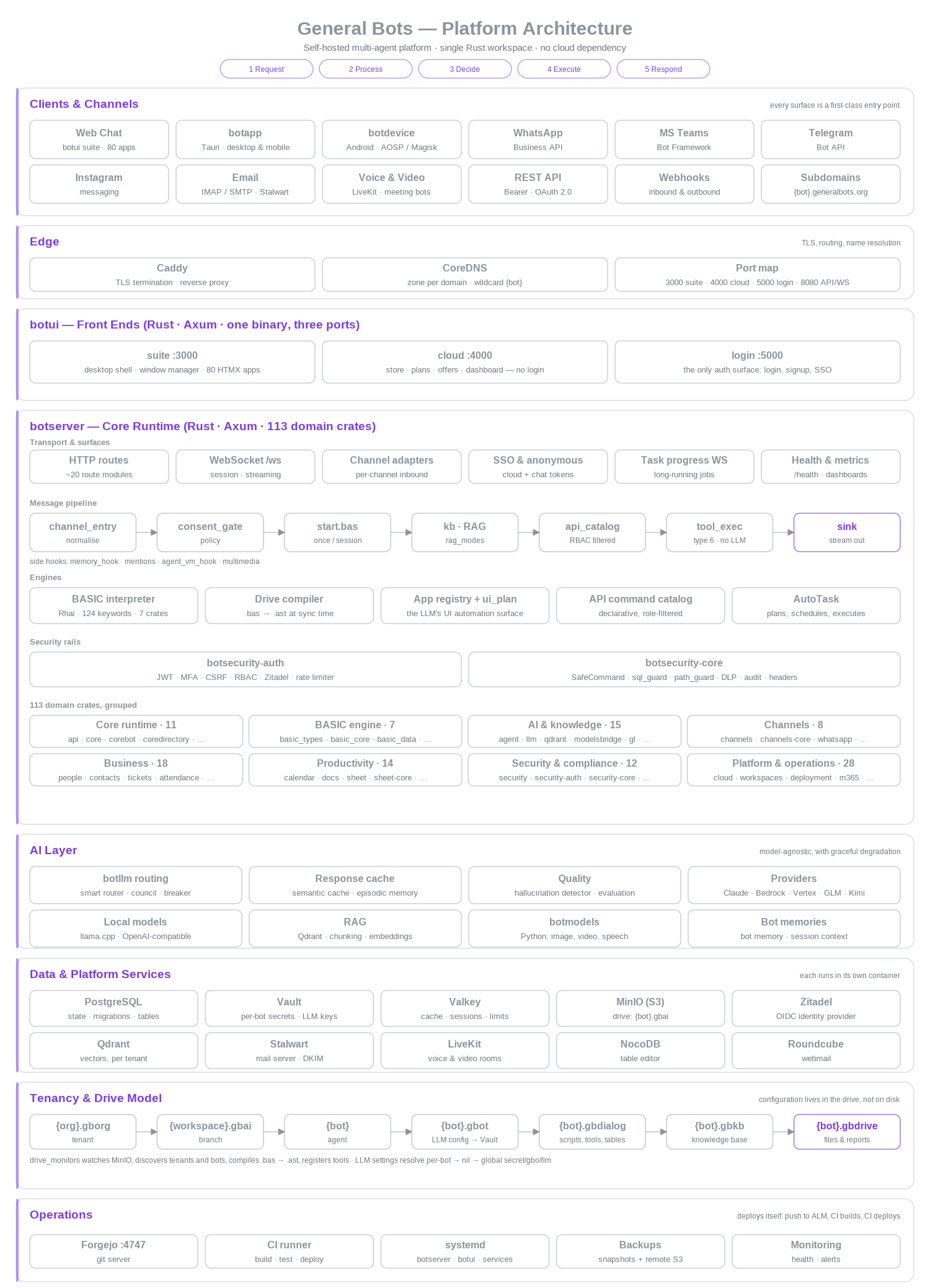
Layers
| Layer | Where in the repository | Owns |
|---|---|---|
| Entry point | botserver/src/main.rs |
Feature-gated module declarations. |
| Server wiring | botserver/src/main_module/ |
Routes, drive monitors and boot work. |
| Bot pipeline | botserver/src/core/bot/ |
Message handling, context, tools and runs. |
| BASIC | botserver/src/basic/keywords/ and botserver/crates/botbasic_*/src/keywords/ |
Keyword registrations. |
| App catalog | botserver/src/apps/registry/ |
all_apps() entries, categories and ownership. |
| Feature crates | botserver/crates/*/ |
Independently compiled capabilities. |
| Schema | botschema/src/ and botserver/migrations/ |
Diesel declarations and SQL migrations. |
The diagrams below are the existing architecture drawings. They are navigation aids; the table above and the crate manifests are the authorities.


Request flow
channel → channel adapter → session → BASIC/context → optional LLM → response → channel
The WebSocket path is the primary chat surface. A message of type 6 (TOOL_EXEC) runs a tool script directly through Rhai without an LLM call; other messages may receive knowledge-base context before generation. The message-type contract is recorded in the root AGENTS.md.
Storage
| Concern | Service | Authority |
|---|---|---|
| Relational data | PostgreSQL, accessed through Diesel | root AGENTS.md; schema in botschema |
| Files and bot content | OtterIO (Drive), S3-compatible | root AGENTS.md; botserver/3rdparty.toml |
| Cache and session data | Valkey (Redis-compatible) | root AGENTS.md; botserver/3rdparty.toml |
| Vectors | Qdrant | root AGENTS.md; botserver/3rdparty.toml |
Security boundary
Authentication, authorization and session management are implemented in the botsecurity-auth crate; shared guards and sanitizers are in botsecurity-core. Secrets are read from Vault (or the bundled OpenBao in the desktop edition) — never from a documentation file. State-changing HTTP endpoints require CSRF protection unless they use Bearer-token auth; this rule is in the root AGENTS.md.
Deployment shape
Production runs on Incus containers, with Caddy as the reverse proxy. The container inventory and the ports are in the root AGENTS.md; the component downloads and checksums are in botserver/3rdparty.toml. The operator-facing procedures are runbooks: Container Deployment, Infrastructure, Scaling and Observability.
Limits
| Claim | Status |
|---|---|
| Framework | Axum and Diesel. Older prose naming Actix-Web or SQLx is wrong. |
| Model names, chunk sizes, top-k and thresholds | Not asserted here; none are stable enough to document from prose. |
| Future architecture plans | Roadmaps live in GitHub issues, not in this book. |
| Database encryption at rest | Not claimed; read the storage authority before asserting it. |
Related
- Module Structure — crate responsibilities from the manifests.
- Building from Source — toolchain and build commands.
- Dev guide — the curated developer reading path.