Data Model 🟡 BETA
A generated app's data model is a set of tables in the bot's database, attached to a task manifest and queried from BASIC with TABLE and FIND.
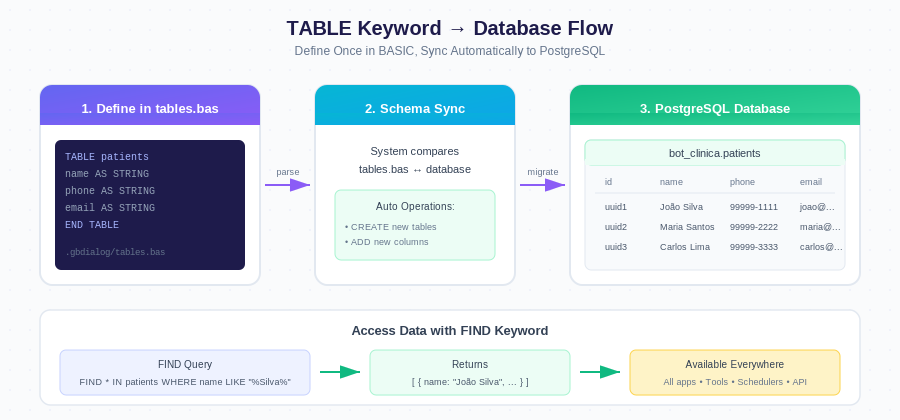

What Is a Table?
tables.bas is a special script parsed at compile time; it defines tables that sync_bot_tables() creates or updates in the bot's database. Ordinary scripts must not CALL it.
Creating Tables
| Step | Mechanism |
|---|---|
| Declare a table | BEGIN TABLE … END TABLE in tables.bas |
| Persist the definition | Compile-time table sync |
| Attach to a task | POST /api/autotask/tables via source_edit |
Adding Fields
Fields are part of the table declaration. Changing a field means changing the declaration and letting the sync path update the database; see the TABLE keyword.
Field Types
Field types follow the declarations supported by the table parser. No extra type list is asserted here; check the compiled keyword reference before using an unfamiliar type.
Searching Data
FIND queries a table from BASIC; see the FIND keyword. The REST surface exposes project and app data through generated routes.
Linking Tables
Relationships are declared in the table definition. The app generation path uses the same tables as any other bot script; no separate generated schema exists.
Shared Data
Apps in one bot share table scope. Cross-bot access uses the memory and delegation keywords described in Multi-Agent Orchestration.
Limits
tables.basis parsed at compile time and is not a callable tool.- Schema changes go through the declaration and sync path, not through an ad-hoc endpoint.
- Diesel
table!macros live only inbotschema.
Related
- Chapter overview - Index of this chapter.
Next Steps
- Designer Guide - Modify tables through conversation
- Examples - Real-world data models
- BASIC Reference - Keyword syntax